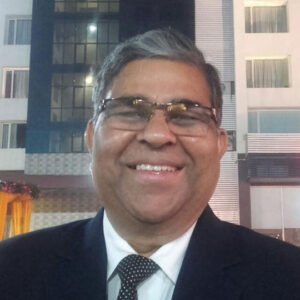
“What did you do to preserve the climate?” “What did I do?” “What did we do?” This probing question defined the address of Mr Rajendra Bhanawat (IAS), Trustee, Foundation for Education and Development, to the young sustainability champions at the 2nd Yuva Sustainability Conference (online), organised on 13 December 2025 under the Yuva Sustainability Internships Programme by Voices of Bharat: Yuva for Sustainability on the theme ‘Beyond COP30: Empowering Youth for Climate Action’.
He firmly believes that climate action begins in conscience, in the small, unseen decisions that never make headlines. To illustrate his point, he shared the fable of the sparrow and the forest fire. When a massive fire engulfed the jungle, a tiny sparrow flew back and forth, dropping single beads of water from its beak onto the roaring flames. The other animals mocked the scale of its effort, to which the sparrow replied, “When the history of this fire is written, my name will be listed among those who tried to quench it, not among those who watched it burn.” This parable cuts through the paralysis of climate anxiety. It reminds us that the scale of the crisis does not absolve anyone of the responsibility to act.
He encouraged young people to begin where they are, using what they have. Knowledge of history and the arts, he said, is as vital in this struggle as physics and chemistry. At the same time, he warned against the “pedestal trap”, the arrogance of the educated assuming they are there to “save” the uneducated. Community engagement, he insisted, must be a two-way exchange. While youth may bring scientific knowledge and modern techniques, communities hold the wisdom of generations.
He evoked the Bishnoi men and women who embraced trees to protect them from a king’s axe, and the Orans — sacred groves where communities would rather starve than cut a branch. Long before the term “sustainability” entered public discourse, India had already been practising it. His message was clear: respect the roots while reaching for the future. Those who go into communities are not there only to teach; they are also there to learn how humanity lived in harmony with nature for centuries.
He then took the audience back to the early 1990s. There were no hashtags, no social media campaigns — only a vast literacy movement that was quiet, determined and relentless. Nearly a million young volunteers helped ten million people learn to read and write. It was a revolution fought not with slogans, but with chalk and courage.
Decades later, standing before a room full of young environmental advocates, Mr Bhanawat did not see mere students. He saw the same latent force, a generation capable of reshaping the destiny of the planet. He challenged them to stop being passive observers and to function instead as a powerful pressure group.
He posed a difficult question: why has no politician fought an election primarily on climate change? The answer, he suggested, lies with the electorate. Politicians follow votes. If young people , the largest demographic, decide that climate protection is the price of their vote, the political landscape could change overnight. He urged youth to lobby at every level, from the local panchayat to the national Parliament.
Mr Bhanawat concluded with a simple yet haunting measure of a life well lived: the “Sleep Test”. Each night, he advised, one should ask: “Did I do something today to damage my climate, or did I do something to preserve it?” If harm has been done and sleep still comes easily, he warned, there is a problem with one’s humanity. But if that question causes restlessness, it means the conscience is alive. It means one is ready to be the sparrow. His enduring challenge is to ensure that when history asks, “What did you do?”, there is an answer grounded in action rather than silence.
The writer is a CA finalist, Institute of Chartered Accountants of India, Ahmedabad