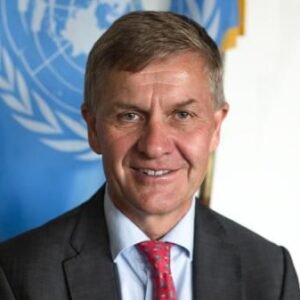
Erik Solheim stated that the baton of climate action must increasingly pass from diplomacy to business, signalling a decisive shift in how the world addresses the climate crisis. Speaking at the 2nd Yuva Sustainability Conference (online), organised on 13 December 2025 under the Yuva Sustainability Internships Programme by Voices of Bharat: Yuva for Sustainability on the theme ‘Beyond COP30: Empowering Youth for Climate Action’, he emphasised the need for practical delivery over repeated deliberation.
For many, the first encounter with the idea of global warming begins in childhood, through science textbooks filled with colourful diagrams explaining greenhouse gases, the greenhouse effect and the ozone layer. At that stage, climate change appears real yet distant, confined to melting polar regions, receding glaciers and faraway geographies disconnected from daily life. Its consequences demand imagination rather than lived recognition. Over time, however, those abstract concepts have evolved into visible and unsettling realities. Summers grow harsher, temperatures soar, and media reports increasingly highlight heatwaves and rising heat stress.
Climate change no longer belongs to a distant future; it confronts the present. The relationship between humanity and nature has undeniably entered a difficult phase. Yet moments of strain also present opportunities for redirection. The world stands at a historical crossroads, where collective choices and voices will determine the course of the future.
Drawing upon his tenure as Former Executive Director of UNEP and Former Minister of Environment of Norway, Mr Solheim reflected on the numerous international agreements and annual climate conferences convened over the past decade. While such platforms are vital for dialogue, he observed that negotiations alone have often struggled to generate sufficient on ground transformation. In contrast, businesses operate differently. Rooted in identifying and solving customer “pain points”, enterprises are positioned to design scalable, pragmatic solutions that integrate sustainability into everyday systems while remaining economically viable.
This structural advantage, he suggested, explains the growing role of business as a driver of sustainability. By engaging directly with citizens, companies can foster innovation that embeds environmental responsibility into routine choices and services.
Mr Solheim also pointed to a significant global shift towards the Global South. India stands out as a leading force in renewable energy, particularly when considered through the scale of green solutions being implemented. Renewable sources now contribute nearly half of the country’s installed power capacity, an ambitious target originally set for 2030 and achieved ahead of time.
Viewed collectively, these developments reveal an important synergy. When businesses deliver tangible solutions to sustainability challenges, they not only address environmental concerns but also contribute to economic growth. For developing economies, this integration of ecology and economy challenges the outdated notion that environmental responsibility must compromise prosperity. Instead, sustainability can function as a pathway to inclusive development.
With the world’s largest demographic dividend in 2026, a window projected to remain open until 2055, India holds a significant opportunity. Aligning this young population with sustainability is therefore essential, not only in shaping professional pathways, but also in influencing daily habits and internalised values. Mr Solheim emphasised that young people can amplify positive action, use social media responsibly and strengthen one another’s efforts. Through such collective engagement, sustainability moves beyond rhetoric and becomes a shared responsibility.
Meaningful change, however, is rarely immediate or linear. It tests patience and demands consistency. Yet sustained effort has the potential to compound over time. Small, deliberate actions can evolve into transformative outcomes. As rivers do not rush yet still reach the sea, so too can steady commitment guide the journey towards a brighter, safer and greener tomorrow.
The writer is a BA (Hons.) Economics graduate, Amity University of Noida.