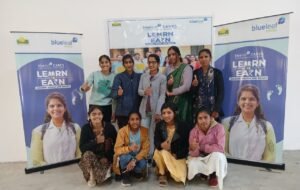
Blueleaf Energy’s flagship Corporate and Social Responsibility (CSR) and Environmental, Social, and Governance (ESG) initiative, Blueleaf CARES, was launched to address a critical structural gap in rural community impact initiatives: the dominance of fragmented, short-term, and sector-specific interventions that fail to deliver sustained community benefit. Drawing from on-ground assessments and socio-economic data, the leadership team identified that while many villages had partial access to government schemes or non-governmental organisation (NGO) programmes, there was a conspicuous absence of integrated support systems that simultaneously addressed healthcare, education, livelihoods, and environmental resilience.
This realisation shaped the foundation of Blueleaf CARES as a holistic, community-centric programme designed to strengthen human, natural, and economic capital together, ensuring long-term and self-sustaining outcomes. As articulated by Tej Pratap Tripathi of Blueleaf Energy and Vikramjit Singh Walia of Smile Foundation (one of Blueleaf’s NGO partners), the intent was to move beyond transactional CSR toward transformational development.
Why an Integrated Development Model?
Rather than adopting a single-sector intervention model, Blueleaf Energy deliberately chose an integrated development framework. Rural challenges are deeply interconnected: low awareness contributes to poor health-seeking behaviour; compromised health outcomes reduce school attendance and productivity; weak livelihoods worsen nutrition and education outcomes; and environmental degradation directly threatens agricultural incomes and water security. Addressing any one of these in isolation would produce only marginal gains.
Blueleaf CARES therefore operates across four interconnected pillars: healthcare, education, livelihood development, and environmental sustainability, enabling cumulative and sustainable change at both household and community levels. This integrated design ensures that improvements in one domain reinforce progress in others, creating a multiplier effect that single-sector CSR projects rarely achieve.
Grounding Strategy in Evidence: Health and Nutrition as a Core Priority
The prioritisation of healthcare and nutrition interventions under Blueleaf CARES is firmly anchored in regional evidence. As per the National Family Health Survey (NFHS5, 2019–21), 40.3% of children under five in Agar Malwa district are stunted, 35.7% are underweight, and 18.7% are wasted, indicating both chronic and acute malnutrition.
Further, 71.6% of children aged 6–59 months are anaemic, signalling severe micronutrient deficiencies, while none of the children aged 6–23 months receive an adequate diet, underscoring the region’s alarmingly low dietary diversity and feeding adequacy. Early-life nutrition challenges are compounded by suboptimal infant feeding practices, with only 55.6% of children breastfed within one hour of birth.
Maternal health indicators reveal equally pressing vulnerabilities. Among women aged 15–49, 59.2% are anaemic, 26.7% are underweight, and only 19.3% have completed ten or more years of schooling. Social determinants further intensify risk: 35.6% of women aged 20–24 were married before 18, and 5.3% of adolescent girls (15–19) are already mothers or pregnant, increasing health risks for both mothers and infants.
While institutional delivery rates stand high at 98.9% and antenatal care coverage is strong (76.5% receiving four or more ANC visits), significant service quality gaps persist. Only 54.8% of pregnant women consumed iron-folic acid supplements for 100+ days, and just 44.6% completed the recommended 180+ days.
Environmental and infrastructural factors further exacerbate health outcomes. Only 39.5% of households use clean cooking fuel, exposing families to indoor air pollution and respiratory diseases. Although 81.4% have access to improved drinking water and 72.3% to sanitation, and 58.9% possess some form of health insurance, large gaps remain in both service utilisation and quality of care.
Compounding this burden is the growing prevalence of non-communicable diseases. Nearly one-fifth of women (19.5%) and men (18.9%) exhibit high blood sugar levels, while 21.2% of women and 25.2% of men suffer from elevated blood pressure. Additionally, 40.7% of women show high-risk waist-to-hip ratios, indicating increased cardiovascular and metabolic risks.
These stark indicators strongly informed the decision to place healthcare and nutrition at the centre of Blueleaf CARES’ development framework.
Education, Livelihoods, and Environmental Action: Completing the Development Ecosystem
Learning gaps, early dropouts, and low female educational attainment shaped the programme’s education strategy, focusing on foundational learning, adolescent engagement, and life-skills development. Livelihood interventions were designed in response to climate variability, income insecurity, and limited non-farm employment opportunities, aiming to enhance household resilience and economic stability.
Simultaneously, environmental priorities emerged from persistent water stress, land degradation, and declining agricultural productivity, positioning conservation, climate-resilient practices, and natural resource management as essential pillars. Together, these four pillars reflect the most pressing, interconnected development needs of the region.
Partnership Architecture: Strategy Meets Grassroots Action
Blueleaf CARES is executed through a collaborative partnership model that integrates corporate stewardship with grassroots expertise. Blueleaf Energy provides strategic direction, governance oversight, funding, and long-term vision. Smile Foundation leads on-ground implementation for healthcare, education, and livelihood interventions, leveraging its extensive grassroots experience. The Centre for Environment Education (CEE) anchors the environmental pillar, focusing on conservation, community awareness, and climate-resilient practices.
This tripartite model ensures strong governance, operational excellence, and deep community engagement, enabling scalable and sustainable impact.
Aligning CSR with ESG and the Clean Energy Transition
Blueleaf CARES is deeply embedded within Blueleaf Energy’s broader ESG and clean energy transition strategy. As a renewable energy developer, the company recognises that infrastructure-led decarbonisation must be complemented by social inclusion and environmental stewardship to achieve a just transition.
According to Tej Pratap Tripathi, Blueleaf Energy’s Senior Manager for Community Engagement, Blueleaf Energy launched Blueleaf CARES because of the company’s belief that as Asia accelerates its clean energy journey, the communities enabling this transformation must never be left behind. Blueleaf CARES complements the company’s renewable energy investments by building resilient communities, supporting climate adaptation, and strengthening long-term social sustainability in project-adjacent regions. This approach not only powers a just transition but also builds trust, secures social license to operate, and transforms potential resistance into long-term partnerships that deliver shared prosperity.
Redefining Responsible Energy Transition for Emerging Economies
Rather than attempting to reinvent development paradigms, Blueleaf CARES focuses on the rigorous execution of proven, human-centric practices, embedding social development directly into clean energy infrastructure. Launched in India in November 2025, the programme aspires to establish a gold standard for integrating social development and environmental resilience within renewable energy ecosystems.
By weaving community well-being into the DNA of clean energy projects, Blueleaf CARES presents a scalable framework for adaptation across diverse Asian contexts. The vision articulated by Tej Pratap Tripathi and Vikramjit Singh Walia underscores that the energy transition can only be considered truly successful when it is inclusive, ensuring that no community is left behind in the shift toward a low-carbon future.
Anoushka Parijat Rudra is pursuing a PGDM in Energy Management at the NTPC School of Business, and this article has been developed as part of the Yuva Sustainability Internship Programme.