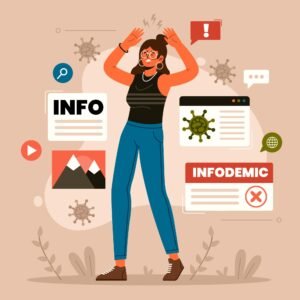
In today’s world, information is everywhere. Data flows constantly through screens, reports, and algorithms, shaping how we understand health, environment, and society. Yet, amid this abundance, clarity often feels out of reach. An address by Dr S Chandrakant Pandav, Public Health Expert and Iodine Man, at a fireside session, organized by Voices of Bharat: Yuva for Sustainability on World Health Day, taught me that knowledge alone is not enough, what matters is how we question and interpret it. I began to realise that sustainability and public health are not just about facts and figures, but about understanding the truth behind them.
Beyond Data: Learning to Question
One of the most powerful lessons I learned is that data should never be accepted at face value. In an age of “floating data” and AI-generated insights, information can easily be misinterpreted or manipulated. To truly understand any issue, especially in public health and sustainability, we must ask three essential questions:
- Who is presenting the data?
- How was it measured?
- What context influences it?
These questions transform passive learning into critical thinking. They allow us to move beyond surface-level understanding and uncover the deeper realities that shape our world.
Sustainability as a Relationship, Not a Statistic
This shift in thinking also changed how I view sustainability. It is no longer just about numbers, carbon emissions, AQI levels, or temperature rise, but about relationships.
Ancient perspectives remind us that humans are not masters of the Earth, but caretakers within a shared system. When we ignore this relationship, imbalance follows. Environmental degradation, climate change, and biodiversity loss are not isolated problems; they are consequences of a broken connection between humanity and nature.
Public Health and the Cost of Misinformation
The importance of questioning data becomes even more critical in public health. The COVID-19 pandemic showed how misinformation can spread as rapidly as disease, influencing behaviour and policy.
Zoonotic diseases, such as Kyasanur Forest Disease, further highlight the connection between environmental disruption and human health. Without reliable data and informed interpretation, it becomes difficult to address the root causes of such crises. Understanding truth, therefore, is not just an intellectual exercise, it is a public necessity.
Urban Reality: Reading the Signs Around Us
The discussion on climate change and the Air Quality Index (AQI) brought this lesson into everyday life. A sudden spike in AQI levels is more than just a number- it is a signal of deeper environmental and health challenges.
Cities today reflect the consequences of unchecked development and poor environmental decisions. Rising pollution levels are directly linked to respiratory illnesses and other chronic conditions. Interpreting these signals correctly requires both scientific understanding and critical thinking.
Skills for a World of Complex Information
- Critical Thinking and Data Literacy
The ability to analyse the source, method, and context of data is essential in distinguishing truth from misinformation.
- Systems Thinking
Sustainability and public health are interconnected. Understanding these links helps address root causes rather than symptoms.
- Effective Communication
Complex information must be translated into clear, actionable messages to create awareness and drive change.
- Self-Discipline and Awareness
Navigating an overwhelming information landscape requires focus, clarity, and a strong sense of purpose.
- From Information to Insight
This experience taught me that the challenge of our time is not the lack of information, but the ability to interpret it wisely. Truth is not always visible in data, it must be uncovered through questioning, reflection, and understanding.
Sustainability and public health demand more than awareness; they require informed action grounded in reliable knowledge. In an age of endless information, asking the right questions becomes a powerful tool for change. It allows us to see beyond numbers, challenge assumptions, and make decisions that truly matter.
For me, this journey has been more than academic, it has reshaped how I see the world. By learning to question data, I am learning to understand it. And in that understanding lies the potential to contribute meaningfully to a healthier, more sustainable future.
The writer is a B.Sc. Environmental Science student at SCS Autonomous College, Puri Odisha.