While listening to the webinar organised by Voices of Bharat: Yuva for Sustainability on World Health Day on the theme “One Health for Sustainable Futures“, Dr Chandrakant S Pandav, Public Health Expert and Iodine Man, shared his perspective on zoonotic diseases and environmental health. His reflection brought attention to the deep and often overlooked connection between humans, animals, and the environment.
At the centre of the discussion was India’s experience with zoonotic diseases, often seen as a public health concern, but rarely understood as part of a larger environmental imbalance.
Human Interference and the Disruption of Natural Balance
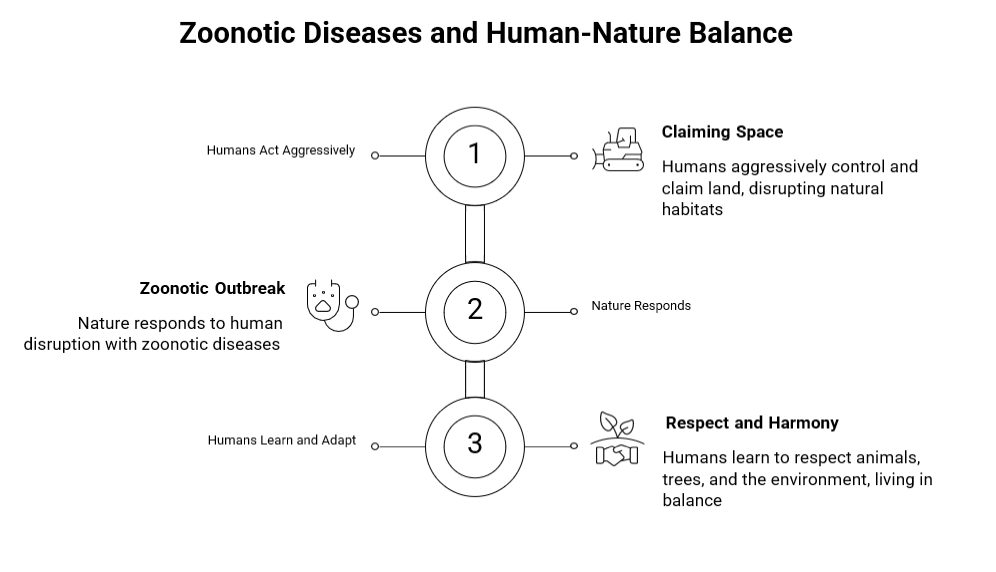
As the conversation unfolded, Dr Pandav spoke with clarity about human behaviour and its consequences. He reflected on how humans often act with a sense of control; expanding into forests, reshaping ecosystems, and claiming natural spaces without fully considering other living beings. Wildlife habitats are disrupted, ecological boundaries are weakened, and systems that once functioned in balance begin to shift.
In contrast, he described nature as inherently peaceful and balanced, where every species has its place. This balance, however, is not fixed. When disturbed, its effects unfold gradually, often in ways that are not immediately visible.
Zoonotic Diseases as a Consequence of Ecological Imbalance
Zoonotic diseases, he explained, are not isolated incidents, but responses to these disruptions. As human activity increases contact with wildlife, the natural separation between species reduces, allowing diseases to pass from animals to humans. What begins as environmental disturbance can quickly develop into wider public health challenges.
The issue, therefore, extends beyond disease management. It lies in recognising how human interference continues to alter ecosystems and increase vulnerability, not only for the environment, but for human health as well.
Rethinking the Human-Nature Relationship
As the interaction progressed, the focus began to shift. The discussion moved from identifying the problem to reflecting on responsibility. There was a growing emphasis on the need to rethink how humans relate to nature, not as something to control, but as something to coexist with. There was a call to respect animals, protect trees, and value the environment as an interconnected system. The idea was not simply about conservation, but about recognising that human well-being is closely linked to the health of the natural world.
What stayed behind was a simple truth that our health, environment, and future depend on how we choose to live with nature. This understanding reframes zoonotic diseases not just as risks to manage, but as reminders of the consequences of imbalance.
Towards Sustainable Living and Disease Prevention
Dr Pandav’s message pointed towards a clear way forward. Living in harmony with nature, rather than dominating it, offers a path towards prevention. By maintaining ecological balance, reducing unnecessary interference, and adopting more sustainable living practices, it becomes possible to lower the risks of zoonotic diseases and support a more stable and peaceful future.