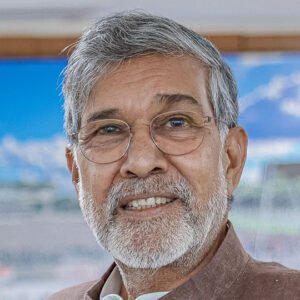
“Sustainability is Dharma, the universal righteousness that sustains life. Dharma in action is Karma,” said Kailash Satyarthi, Nobel Peace Laureate, who has recently come out with his book Karuna: The Power of Compassion.
He said climate and social crises are largely man-made and require urgent collective action. He urged reduction in carbon emissions and building a more compassionate and equitable world. Referring to his book Karuna: The Power of Compassion and the Satyarthi Movement for Global Compassion, he said sustainability must be linked with human rights, including access to clean water, ecological balance, inclusive growth and compassionate education. “You are not just the leaders of tomorrow, you are the today of the nation,” he said, urging youth to take immediate responsibility.
Satyarthi flagged concerns over rising stress among students due to excessive competition and suggested introducing “compassion circles” in universities. He also stressed the need for real-world engagement in education. He cautioned against misuse of data, artificial intelligence and deepfakes, and called for developing a CQ “compassion quotient” alongside IQ and EQ.
He was delivering the keynote address at the 4th Yuva Sustainability Conference (online), which was organised by Voices of Bharat: Yuva for Sustainability, an initiative of Sustainability Karma, on the occasion of Earth Day, which was on the theme of Our Power, Our Planet.
The conference brought together diverse perspectives from academia and industry, underscoring the urgency of integrating sustainability into education, policy and practice. Dr NC Wadhwa, Director General, Manav Rachna Educational Institutions, drew attention to pressing environmental challenges, including pollution, extreme weather events and glacial retreat, calling for sustainability to be embedded in both education and research. Building on this, Professor Nupur Prakash, Vice Chancellor, The NorthCap University, emphasised on the need to weave sustainability across disciplines through community engagement and student-led initiatives.
Professor Harpreet Kaur, Principal, Mata Sundri College for Women, University of Delhi, highlighted the role of social enterprise in addressing local challenges, promoting circular economy models and advancing inclusive, sustainable growth. Focusing on individual responsibility, Professor Seema Agrawal, Principal, Kanoria PG Mahila Mahavidyalaya, University of Rajasthan, stressed the importance of mindful consumption, noting, “Our garbage is our responsibility,” and underscoring how everyday choices contribute to environmental impact. Extending these insights, Prof. L. Ramesh, Join Registrar, DR M.G.R Educational and research Institute and President The institution of green Engineers, drew attention to the critical gaps that continue to hinder progress, the disconnect between knowledge and implementation, and between broader vision and grassroots action and the need to bridge these gaps while turning constraints into opportunities and translating intent into meaningful, on-the-ground change.
A panel discussion on green careers, moderated by Professor Avinash Singh, Former Pro Vice Chancellor, University of Technology and Management, Shillong, and Director General and Pro-Vice Chancellor of the Manglayatan University, examined pathways for sustainable employment.
Raj Bhatia, CMD, Bony Polymers, and President of Faridabad Industries Association, called for policy reforms and practical sustainability education, while Geet Kapur, Founder, Quantum Shift Consulting, encouraged students to explore opportunities in green technology and artificial intelligence. Professor Dr Vikas Rajput, Director, Parallel Living Research & Consulting, cautioned against development that overlooks ecological balance.
The importance of inclusive dialogue was highlighted by Professor Meenakshi Narula, Director, JIMS Vasant Kunj, who emphasised the need to listen to marginalised voices in advancing sustainable development. Dr Richa Yadav, Assistant Professor, Haridev Joshi University of Journalism and Communication, reflected on the growing role of youth leaders in promoting sustainable living and climate awareness.
The session further provided a platform for Yuva Sustainability interns to present their perspectives on climate action, responsible consumption and community-led solutions. Aarohi Soral, 3rd year student of BSC Biology, Kanoria PG Mahila Mahavidyalya, are her perspectives on ecosystem restoration, Diksha Vaid, Jammu and Kashmir, shared her perspective on Environmental Governance, Sai Dinesh, Final year student of Department of Electronics and Communication from Sri Venteswara college of technology, Tamil Nadu, shared his perspective on Equitable Energy transitions. Sara shared her perspective on Climate Migration, Graduation BA from Deendayal Upadhyay, Gorakhpur University, Uttar Pradesh
The session also served as a platform for Yuva Sustainability interns to present their perspectives on key issues such as climate action, responsible consumption, and community-led solutions. Aarohi Soral, a third-year B.Sc. Biology student from Kanoria PG Mahila Mahavidyalaya, Jaipur, shared her insights on ecosystem restoration. Diksha Vaid, graduate from University of Jammu spoke on environmental governance, while Sai Dinesh, a final-year student from the Department of Electronics and Communication at Sri Venkateswara College of Technology, Tamil Nadu, presented his views on equitable energy transitions. Sara, BA graduate from Deendayal Upadhyay Gorakhpur University, Uttar Pradesh, highlighted the critical issue of climate migration. Together, these presentations reflected the diverse and thoughtful engagement of young voices in advancing sustainability discourse.