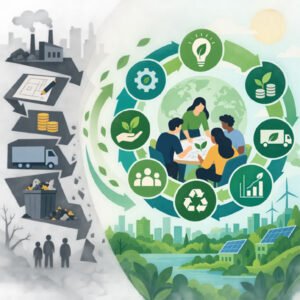
Problem
In sustainability work, one recurring challenge is the tendency to think in silos. A chemist may only see the chemical processes, a commerce graduate may focus solely on financial viability, and a sociologist may limit themselves to community behaviour. This fragmented approach leaves solutions incomplete, unable to capture the complexity of environmental issues.
Learning
Ms. Shalini Sharma, in the Yuva Sustainability Webinar, emphasized that industry now seeks graduates who can move beyond linear thinking. She highlighted three essential qualities:
- an interdisciplinary mindset, connecting design, finance, logistics, and waste disposal into one circular framework,
- data literacy and impact measurement, the ability to interpret large datasets and translate them into meaningful sustainability outcomes, and
- cross‑functional collaboration, the skill to work with diverse teams and stakeholders to create solutions that are practical and scalable.
Her words carried a clear message: sustainability is no longer a fringe concern. It has moved into boardrooms, becoming part of corporate strategy. And for young people, attitude matters as much as technical expertise — the willingness to learn across domains is what makes us valuable.
Application
Embedding these insights into practice transforms sustainability projects. An interdisciplinary mindset ensures that waste segregation is not just about bins, but about chemistry of materials, economics of recycling, and sociology of awareness. Data literacy allows us to track volumes, interpret recycling rates, and measure real impact. Cross‑functional collaboration brings together diverse voices to design solutions that are integrated rather than isolated.
By applying Ms. Shalini Sharma’s learnings, sustainability projects evolve from fragmented efforts into coherent systems. They become more than academic exercises — they reflect the standards industry is looking for, and they prepare us, as students, to step into the professional world with confidence and clarity.
Thus, “Sustainability is no longer a fringe concern — it is part of corporate strategy, and young professionals must learn to think in circles, not lines.”