Vice Chancellor, The NorthCap University, Gurugram, Haryana
The NorthCap University, Gurugram, recipient of the Second Prize under the Community Impact category at the Sustainability Karma Campus Leadership Awards 2026, is recognised for integrating sustainability education with credit-linked community service, student-led clubs, village adoption and experiential outreach initiatives.
The NorthCap University has integrated sustainability and community engagement into its academic framework by embedding environmental education, experiential learning and social responsibility across disciplines. Sustainability is supported through a Certificate Programme in Sustainable Development, open elective courses and compulsory Environmental Studies for all students.
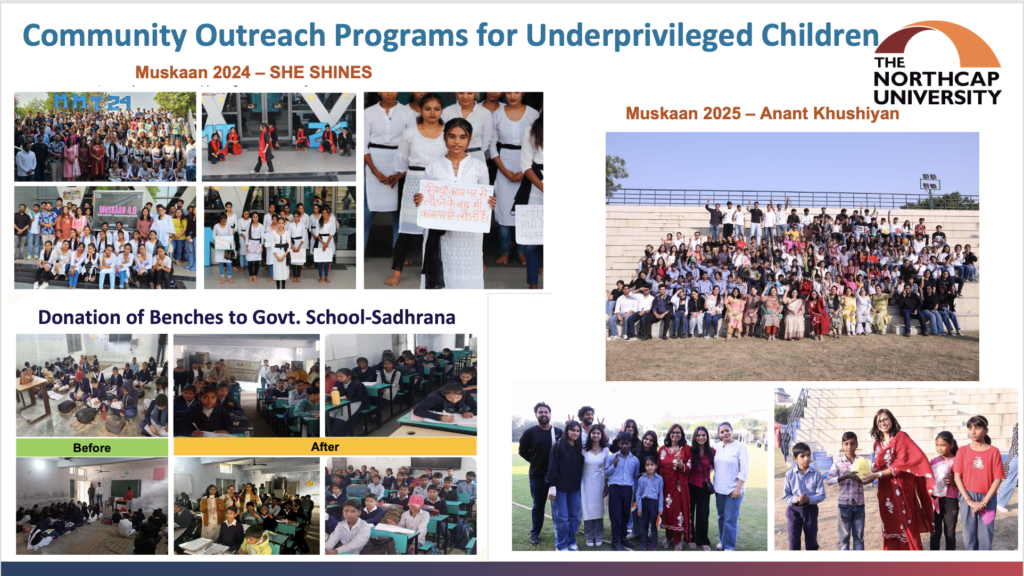
A defining feature of the initiative is the integration of credit-linked community service into the curriculum, making the University one of the first institutions to institutionalise community engagement as an academic requirement. Sixteen student community service clubs regularly organise awareness campaigns, plantation drives and sustainability outreach programmes aligned with national missions and the Sustainable Development Goals.
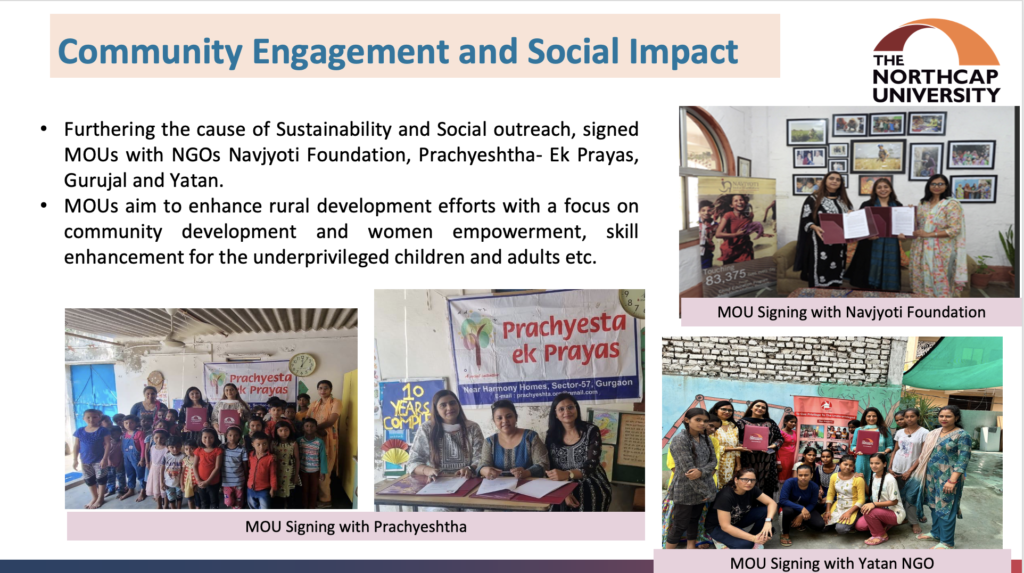
The University has also adopted five villages under the Unnat Bharat Abhiyan, implementing initiatives such as vermicomposting, literacy camps and plantation drives in partnership with NGOs, demonstrating how higher education can create lasting community impact.
Description
The initiative integrates sustainability education with structured community engagement in alignment with the Sustainable Development Goals and the National Education Policy 2020.
Key activities include:
- Mandatory community service equivalent to 140 hours for every student.
- Certificate Programme in Sustainable Development.
- Open elective courses on sustainability and the environment.
- Sixteen student-led community service clubs.
- Awareness campaigns, plantation drives and waste management initiatives.
- Adoption of five villages under the Unnat Bharat Abhiyan.
- Vermicomposting, water conservation and literacy programmes in adopted villages.
Objectives
The initiative aims to:
- Integrate sustainability education with community engagement.
- Promote environmental awareness and social responsibility.
- Enable students to apply academic knowledge to real-world challenges.
- Support national sustainability missions and the Sustainable Development Goals.
- Foster inclusive, community-driven development.
Innovation
The initiative embeds community service into the academic curriculum through a credit-linked, outcome-based model. By combining project-based learning, village adoption, NGO partnerships and student-led sustainability clubs, it creates a participatory framework that connects academia with community development.
Outcomes
The initiative has generated measurable educational, environmental and social benefits.
Key achievements include:
- Engaged thousands of students annually through structured community service.
- Implemented vermicomposting and sustainability initiatives in adopted villages.
- Conducted plantation drives and cleanliness campaigns.
- Strengthened environmental awareness and community participation.
- Developed students’ leadership, empathy and problem-solving skills.
Scalability
The initiative provides a structured model that can be adopted by higher education institutions seeking to integrate sustainability into academic programmes.
Its scalable components include:
- Credit-linked community service.
- Sustainability-focused academic programmes.
- Student-led community service clubs.
- Village adoption under the Unnat Bharat Abhiyan.
- NGO partnerships.
- Experiential and project-based learning.
By embedding sustainability into teaching, outreach and community partnerships, the model offers a practical framework for institutions seeking to create meaningful environmental and social impact.