Principal & Professor (CSE), Aarupadai Veedu Institute of Technology, Paiyanoor, Tamil Nadu
Aarupadai Veedu Institute of Technology (AVIT), Paiyanoor, recipient of the Third Prize under the Holistic Sustainability Excellence category at the Sustainability Karma Campus Leadership Awards 2026, is recognised for integrated initiatives across solar energy, smart monitoring, water reuse, waste management, biodiversity, sustainability education and community outreach.
Aarupadai Veedu Institute of Technology (AVIT) promotes holistic sustainability by integrating environmental stewardship, social responsibility and technological innovation across campus operations and academic programmes. The initiative addresses energy consumption, water scarcity, waste management, biodiversity conservation and climate awareness while fostering responsible citizenship among students.
Energy conservation is supported through a 126 kW solar power system, DCS–IoT-based energy monitoring, sensor-based equipment, LED lighting and energy-efficient appliances. Water sustainability is strengthened through 15 rainwater harvesting chambers, groundwater recharge, wastewater recycling and a sewage treatment plant with a capacity of six lakh litres per day. Treated water is reused for landscaping and sanitation, while atmospheric water generation technology supplements the campus drinking water supply.
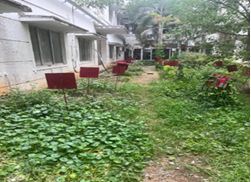
The 9,200 sq. m green campus supports biodiversity with 1,614 trees, 109 palms and 1,670 potted plants. Biodegradable waste is composted on campus, improving soil fertility and reducing waste. Social responsibility is advanced through local employment opportunities and outreach programmes under the Unnat Bharat Abhiyan (UBA), including the installation of solar street lights and seed-ball initiatives in neighbouring villages.
Students actively participate in sustainability through curriculum integration, eco-club activities and environmentally responsible celebrations. A medicinal plant garden supports research into bio-based products, while innovation in renewable energy, smart energy management, IoT-enabled water systems, smart farming and battery-less UPS technologies positions AVIT as a model for sustainable campus development.
Description
The sustainability initiative at AVIT was introduced in response to growing environmental challenges, including climate change, resource depletion, water scarcity and increasing waste generation. Recognising its responsibility in shaping future professionals, the institution integrated sustainability into campus operations, academic programmes and community engagement, transforming the campus into a living model of environmental responsibility.
Key initiatives include:
- Installation of a 126 kW solar power system.
- DCS–IoT-based energy monitoring.
- Rainwater harvesting structures.
- Wastewater recycling and sewage treatment.
- Daily segregation and composting of biodegradable waste.
- Extensive tree plantation and green landscaping.
- Development of a medicinal plant garden supporting research into bio-based products.
- Curriculum-integrated environmental education.
- Eco-club activities and sustainability awareness programmes.
- Community engagement through local partnerships and outreach initiatives.
Objectives
The initiative aims to:
- Reduce the campus carbon footprint through renewable energy and smart energy management.
- Address water scarcity through rainwater harvesting, wastewater treatment and water reuse.
- Minimise waste through segregation, composting and circular resource management.
- Enhance biodiversity through tree plantation and green infrastructure.
- Promote environmental awareness among students and staff.
- Support surrounding communities through employment opportunities and sustainability outreach.
- Integrate environmental, social and resource sustainability into campus operations and learning.
Innovation
AVIT integrates advanced technology with experiential sustainability education.
Innovative features include:
- A DCS–IoT-enabled energy monitoring system integrated with a solar power grid.
- Atmospheric water generation technology to strengthen water security.
- Circular resource management through composting and wastewater reuse.
- A medicinal plant garden supporting student-led research and bio-based product development.
- A campus that serves as a living laboratory for renewable energy and sustainability innovation.
Outcomes
The initiative has delivered measurable environmental, educational and social benefits.
Key outcomes include:
- Reduced electricity consumption and carbon emissions through a 126 kW solar power system and smart energy monitoring.
- Improved water self-sufficiency through 15 rainwater harvesting structures and treatment of six lakh litres of wastewater per day.
- Reduced landfill waste through composting of biodegradable waste.
- Enhanced biodiversity through the maintenance of more than 1,600 trees.
- Increased environmental literacy among more than 1,400 students.
- Improved community access to solar lighting and sustainability awareness through UBA outreach programmes.
Scalability
The initiative has been designed as a modular model that can be adopted by other educational institutions.
Its core components include:
- Rooftop solar power generation.
- IoT-based energy monitoring.
- Rainwater harvesting.
- Wastewater treatment and reuse.
- Composting and circular resource management.
- Biodiversity enhancement.
- Curriculum-integrated sustainability education.
- Student-led innovation projects.
Knowledge sharing through institutional visits, collaborations and technical demonstrations has encouraged wider adoption, while community engagement under national programmes demonstrates the model’s potential for broader implementation across educational institutions and rural communities.