President, Manav Rachna Educational Institutions, Faridabad, Haryana
Manav Rachna Educational Institutions, Faridabad, recipient of the Second Prize under the Energy and Climate category at the Sustainability Karma Campus Leadership Awards 2026, is recognised for Green Grah, combining waste-to-resource innovation, recycled community assets, large-scale tree plantation, eco-walls and cleaner urban infrastructure.
Green Grah is a flagship sustainability initiative that addresses urban environmental challenges through circular economy principles, community participation and sustainable infrastructure. The programme promotes responsible resource use while creating measurable environmental and social impact.
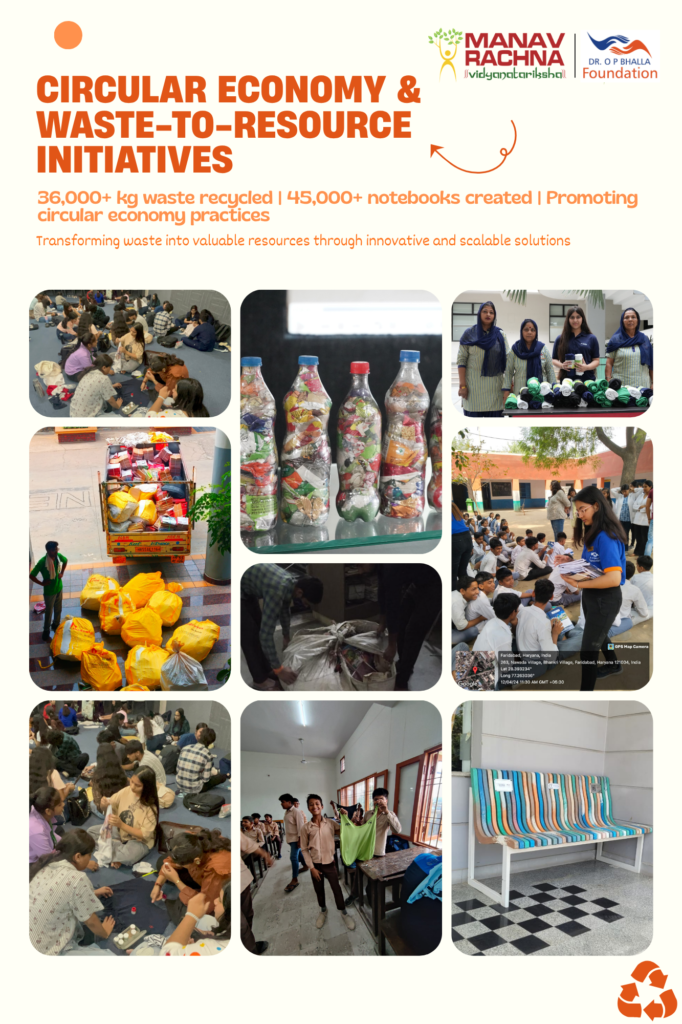
Plastic waste generated within communities is recycled into durable benches for public spaces, while over one lakh kilograms of paper waste have been converted into approximately 40,000 notebooks for underprivileged children. These initiatives reduce landfill waste while creating lasting community value.
The initiative also strengthens urban ecosystems through the plantation of more than 55,000 trees, development of seven eco-walls and the establishment of a PNG-based crematorium, demonstrating how integrated environmental action can create cleaner, greener and more sustainable communities.
Description
Green Grah integrates environmental responsibility into community life through waste management, resource efficiency, urban greening and sustainable infrastructure.
Key activities include:
- Recycling plastic waste into benches for community spaces.
- Converting over one lakh kilograms of paper waste into approximately 40,000 notebooks.
- Distributing recycled notebooks to underprivileged children.
- Planting more than 55,000 trees.
- Developing seven eco-walls for vertical greening.
- Establishing a PNG-based crematorium to promote cleaner urban infrastructure.
Objectives
The initiative aims to:
- Promote circular economy practices.
- Reduce landfill waste through recycling and resource recovery.
- Increase urban green cover.
- Encourage sustainable urban infrastructure.
- Create environmental and social value through community participation.
Innovation
Green Grah combines waste management, urban greening and sustainable infrastructure within a single circular economy framework. By transforming waste into community assets and integrating innovative solutions such as eco-walls and a PNG-based crematorium, the initiative demonstrates a practical and community-driven approach to sustainable urban development.
Outcomes
The initiative has generated measurable environmental and social benefits.
Key achievements include:
- Reduced landfill waste through recycling and resource recovery.
- Converted plastic and paper waste into valuable community assets.
- Distributed approximately 40,000 notebooks to underprivileged children.
- Planted more than 55,000 trees to improve urban green cover.
- Developed seven eco-walls to promote urban biodiversity.
- Reduced emissions through a PNG-based crematorium.
Scalability
The initiative offers a flexible model that can be adapted across educational institutions, municipalities and urban communities.
Its scalable components include:
- Waste-to-resource recycling initiatives.
- Urban greening through tree plantations.
- Vertical greening using eco-walls.
- Sustainable community infrastructure.
- Partnerships with local communities and civic bodies.
By combining modular interventions with strong community participation, Green Grah provides a practical framework for institutions seeking to create measurable environmental and social impact.