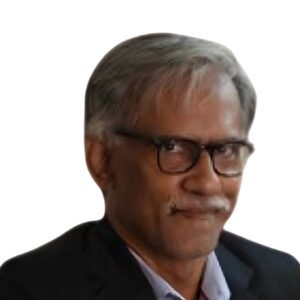
The future of employment will not be shaped by artificial intelligence and advanced technology alone. Agriculture, healthcare, personal services and the informal economy will also remain important sources of jobs, according to senior journalist and editor George Skaria.
Skaria was speaking at the sixth Yuva Sustainability Webinar, titled Who Will Build a Sustainable Bharat? Green Skills, AI and the Future of Work, organised by Voices of Bharat: Yuva for Sustainability under its Yuva for Sustainability Internship Programme 2026.
It brought together industry leaders, sustainability practitioners and young participants to examine emerging green skills, the impact of artificial intelligence, changing industry expectations, curriculum reform and employment opportunities in India’s sustainability transition.
The panel featured Dr Tanu Jain, CEO of Bareilly Cantonment Board; Vijay Menon, Chief Operating Officer of Navitas Solar; Aman Pannu, President of DCM Shriram Foundation; Shalini S Sharma, Assistant Secretary General of PHD Chamber of Commerce and Industry; and Skaria.
The discussions included an interactive question-and-answer session featuring young participants from educational institutions across India.
Referring to the World Economic Forum’s Future of Jobs Report, Skaria highlighted the diverse nature of employment opportunities expected to emerge in the coming years.
While AI specialists, data scientists and technology professionals feature prominently in discussions about future employment, he pointed out that farm workers, delivery personnel, salespeople, barbers and workers in the care economy, including nurses and home-care professionals, also feature in the report’s employment outlook.
His observations drew attention to a frequently overlooked dimension of the future-of-work debate: the continued importance of occupations dependent on human interaction, physical services and local economic activity.
MSMEs Missing from the Sustainability Conversation
Turning to India’s economy, Skaria questioned whether the sustainability discourse was paying sufficient attention to micro, small and medium enterprises (MSMEs).
He noted that MSMEs contribute approximately 30 per cent of India’s GDP and support employment for around 120 million people, including a substantial workforce associated with the informal economy.
Despite their contribution, he observed that sustainability awards and corporate recognition programmes frequently concentrate on large companies, including major industrial groups and cement manufacturers.
Skaria argued that the country’s sustainability priorities needed to reflect the economic importance of smaller enterprises rather than focusing predominantly on large corporations.
He also questioned the tendency among companies to place sustainability within the corporate social responsibility (CSR) framework, arguing that environmental responsibility should extend beyond statutory CSR expenditure.
According to him, corporate CSR activities have traditionally concentrated on sectors such as healthcare and education, while sustainability has received relatively limited attention.
Responsible Leadership Must Go Beyond Corporate Commitments
Responding to a question on responsible leadership and corporate purpose during the webinar, Skaria examined the difference between sustainability commitments and their implementation.
He cited ITC’s early adoption of the people, planet and profit approach, acknowledging it as a pioneering initiative at a time when sustainability was not yet a mainstream corporate concern.
However, he questioned the extent to which such commitments were consistently translated into practice.
As another example, he referred to Evolve Back Resorts, part of the Orange County Resorts group, and its approach to responsible tourism.
He highlighted how sustainability considerations could be integrated into operational details, ranging from materials used in hospitality services to manure used in maintaining resort landscapes.
“There is some gap between what we say, and what is actually practised,” Skaria observed, emphasising the need for companies to bridge the divide between their stated commitments and everyday operations.
Young Participants Raise Questions on Sustainable Businesses
The role of entrepreneurship in India’s sustainability transition also emerged during an interaction with Jagriti Koushik, a Yuva for Sustainability Intern from Assam pursuing a bachelor’s degree in zoology at Cotton University, Guwahati.
Koushik asked Skaria whether India needed more sustainability-focused start-ups or whether existing businesses should first become more sustainable.
Her question highlighted two dimensions of India’s green transition: the emergence of new businesses offering environmental solutions and the transformation of established enterprises whose operations influence resource consumption, employment and environmental outcomes.
The interaction also reflected the webinar’s wider objective of bringing young people into conversations with industry leaders and sustainability professionals about the future of employment and entrepreneurship.
Sustainability Education Must Begin at School Level
Asked how educational institutions could prepare students for a changing technological and employment landscape, Skaria advocated introducing sustainability awareness much earlier in the learning process.
He argued that environmental education should not be confined to universities or specialised higher education programmes but should begin at school level.
Such exposure, he suggested, could help students develop an understanding of sustainability through direct experience rather than classroom instruction alone. At the higher education level, Skaria referred to sustainability-focused management education at the Indian Institute of Management Indore as an example of specialised learning opportunities for professionals seeking careers in the field.
However, he cautioned that professionals aspiring to chief executive positions would require broader general management capabilities alongside sustainability expertise. His comments pointed towards the need for different approaches to sustainability education at different stages of learning and professional development.
Preparing Young India for the Future of Work
The webinar’s discussions reflected wider concerns about whether India’s education and employment systems are adequately preparing young people for the emerging green economy. By bringing together industry representatives, sustainability practitioners and young participants, the session explored how technological change, industry requirements and sustainability priorities could reshape professional opportunities.
Skaria’s remarks offered a broader perspective on India’s future workforce, questioning an employment narrative dominated by emerging technologies and large corporations.
While technological skills will remain important, he drew attention to the continued relevance of agriculture, services, the care economy and smaller enterprises.
His emphasis on responsible corporate practices and early sustainability education also suggested that preparing for the future of work involves more than producing technically qualified graduates.
The challenge, as reflected in his observations, is to ensure that sustainability becomes part of how businesses operate, how students learn and how India approaches employment across its diverse economy.